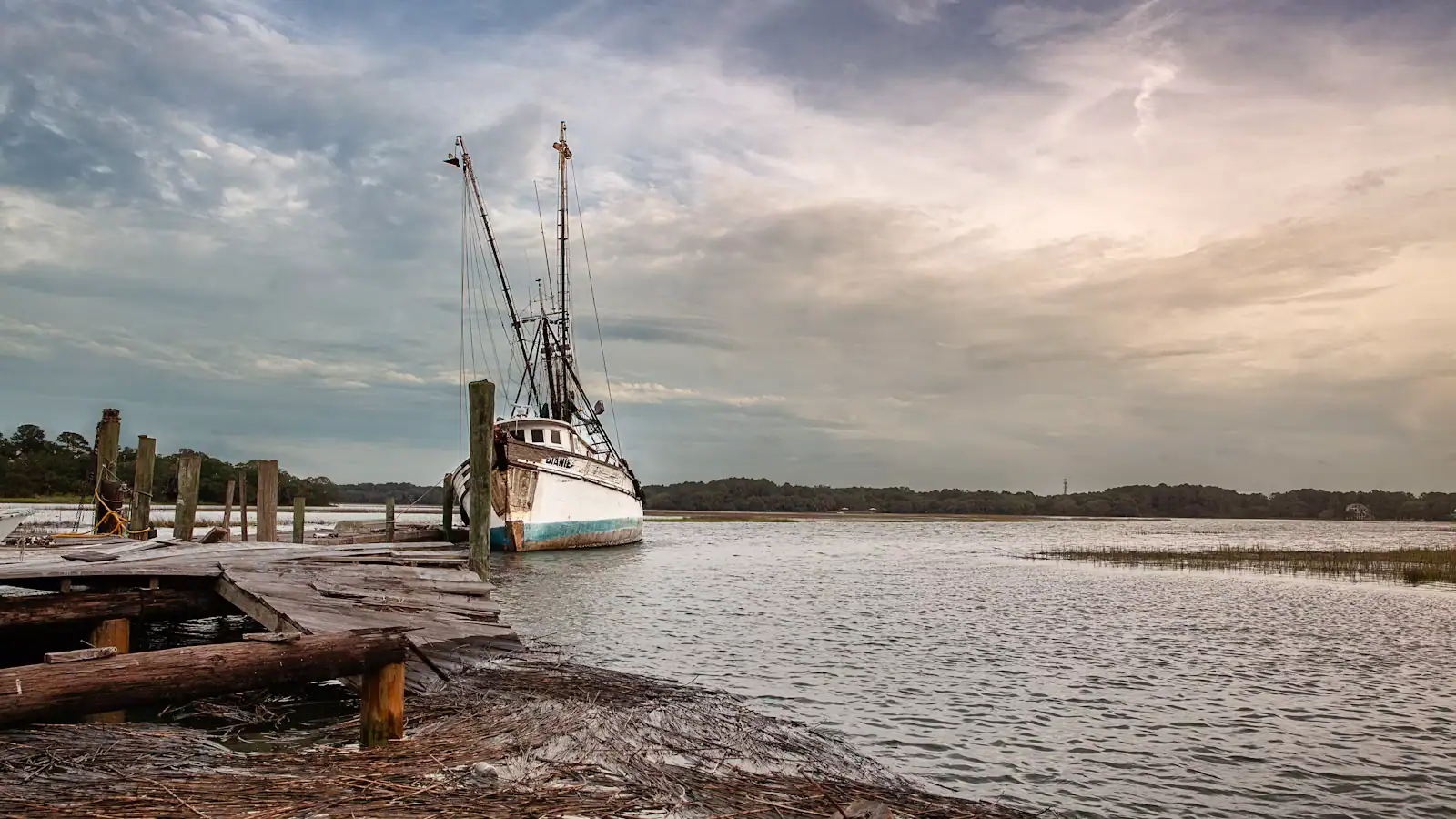
Daufuskie Island sits across Calibogue Sound from Hilton Head, about five square miles of it, with a few hundred year-round residents, no bridge and no plans for one. Most of the roads are dirt. You get there by boat, you get around by golf cart, and the day runs on the ferry timetable rather than on yours.
It is the best day trip available from Hilton Head, and the one most likely to go wrong for people who treat it casually.
The ferry
Public passenger ferries to Daufuskie run from Broad Creek Marina on Hilton Head across to Freeport Marina on Daufuskie, a crossing of roughly 45 minutes through the sound. Parking at Broad Creek Marina is normally free, which is not true of most places you park on this island.
The published summer pattern for 2026, roughly 1 May to 31 August, offers round trips at 9am returning 4pm, 11am returning 6pm, and 1pm returning 8pm, with the latest option running Wednesday to Saturday only. Operators ask you to arrive 30 minutes before departure. Outside summer the schedule thins considerably, so check the operator's current times rather than this page before you plan a date.
Expect round-trip fares in the region of $50 to $60 an adult, with children and pets charged less and luggage extra. Published rates vary between operators and seasons, so confirm when you book. Other boats serve the island from Bluffton and, seasonally, from Harbour Town; the private communities of Haig Point and Melrose run their own separate services for members and guests.
Book the ferry before you book anything else on the island, and book it ahead in summer. This is the one link in the chain with no alternative.
Golf carts, and why you need one
Freeport Marina is where you land, and it is not within walking distance of most of what you came for. Cart rental is available at the marina, and the sensible move is to reserve one at the same time as the ferry so it is waiting when you step off.
Carts here are not a novelty. They are the island's transport, the roads are largely unpaved, and after rain the ruts are real. Drive slowly, give way to residents, and stay out of driveways and private tracks. Daufuskie is not a theme park with a service road; it is a place where a few hundred people live with a public road network of dirt.
What is actually there
First Union African Baptist Church, built in 1884 on land given after an earlier church burned, is the island's most significant historic building and remains in use as a place of worship. Treat it accordingly: look, do not wander in on a service, and ask before photographing.
The Mary Fields School, built in 1933 for the island's Gullah children, is where the writer Pat Conroy taught during the 1969 to 1970 school year, an experience that became The Water Is Wide. The two-room building now houses a coffee shop on one side and an indigo studio on the other, which is a more cheerful fate than most historic schoolhouses get.
Iron Fish Gallery, the studio of metal artist Chase Allen, who makes fish and other marine sculpture in a Gullah cottage on the island. It has become the island's most-visited stop after the marina, and works on a trust system that tells you something about the place.
Daufuskie Island Rum Company, for visitors over 21, distils and bottles by hand on the island.
Bloody Point, at the island's southern tip, is named for fighting during the Yamasee War of 1715. The beaches on this side are wide, empty and shell-strewn, which is the main reason to bring a cart and keep driving past the marina.
Old Daufuskie Crab Company at Freeport Marina is the obvious lunch, and on a day trip the timing works: eat before the return ferry rather than trying to fit a meal into the middle of the loop.
Golf exists on the island, at courses attached to the private communities, and availability for day visitors has changed over the years. Arrange it in advance or not at all.
The history you are actually visiting
Daufuskie's Gullah community descends from West and Central Africans enslaved on the island's cotton plantations, and after the Civil War families bought and farmed land here. With no bridge and no road, the island stayed isolated far longer than Hilton Head did, which is precisely why Gullah language, foodways and church life persisted here into living memory with so little outside interference.
The oyster industry sustained the island until pollution in the Savannah River closed the beds in the late 1950s, and the population fell away afterwards as work disappeared. The Mary Fields School, and the year Pat Conroy spent teaching in it, describe a community already under that pressure. Daufuskie sits within the federally designated Gullah Geechee Cultural Heritage Corridor, as does Hilton Head.
Several island cemeteries are family burial grounds still in use. They are not attractions. If a guide takes you to one, follow their lead entirely.
Guided history tours of the island are run by operators who live there, and they are worth the money on a first visit. A guide gets you past the postcard version in an afternoon.
Timing a day trip properly
| Ferry | Time on the island | What it suits |
|---|---|---|
| 9am out, 4pm back | About six hours | The full island: cart, Bloody Point, the church, the school, gallery, lunch and a swim |
| 11am out, 6pm back | About six hours | Same, with a later start and dinner back on Hilton Head |
| 1pm out, 8pm back, summer, Wed–Sat | About six hours | Afternoon and evening, best in high summer when the light holds late |
Six hours is right. Four would be a scramble, and there is no way to extend the day if you miss the return: the last boat is the last boat, and accommodation on Daufuskie is limited and rarely available at short notice.
What to bring and book ahead
Book the ferry and the cart together, in advance, especially between June and August. Bring water, sun protection, insect repellent for the wooded interior, and swimming things if the tide suits. Carry some cash; several island businesses are small operations and card acceptance is not universal. There is no supermarket and no full service station, so anything you might need during the day comes with you on the boat.
Check the weather before you go rather than when you arrive. Summer thunderstorms build over the mainland in the afternoon, and the crossing is exposed. And check the tide if the beach is a priority, because at high water the Bloody Point strand narrows considerably.
Visiting an island where people live
Daufuskie gets a few hundred day visitors on a good summer day, into a community of a few hundred residents. That ratio is the whole etiquette lesson.
Stay on public roads. The dirt tracks that look like adventurous shortcuts are usually somebody's driveway, and the island has no signage industry to tell you so.
Drive the cart slowly, especially past houses and around blind bends. Dust is a genuine nuisance for people whose homes sit ten feet from the road.
Ask before photographing houses, churches, cemeteries or people. This applies more here than on Hilton Head, not less, because the island is small enough that the photograph will circulate.
Buy something. Daufuskie's economy runs on day visitors, the artists, the distillery, the crab company, the guides and the cart rental, and the difference between a respectful visit and an extractive one is often just whether you spent any money with the people who live there.
Take your rubbish back to the mainland if the bins are full. Waste leaves this island by barge.
Last updated
Opening hours, ordinances and prices move with the season. We re-check this guide rather than rewrite it, and the date above is the last time someone did. How we research and correct.