Hilton Head is a cycling island in a way that very few American beach destinations are, and the numbers are the reason. The town maintains more than 72 miles of public pathway. The private communities add roughly another 50 inside their gates, with Sea Pines alone contributing about seventeen. The League of American Bicyclists rates the island a Gold-level Bicycle Friendly Community, a designation most towns this size never approach. The paths are paved, flat, shaded for much of their length and separated from traffic rather than painted onto it.
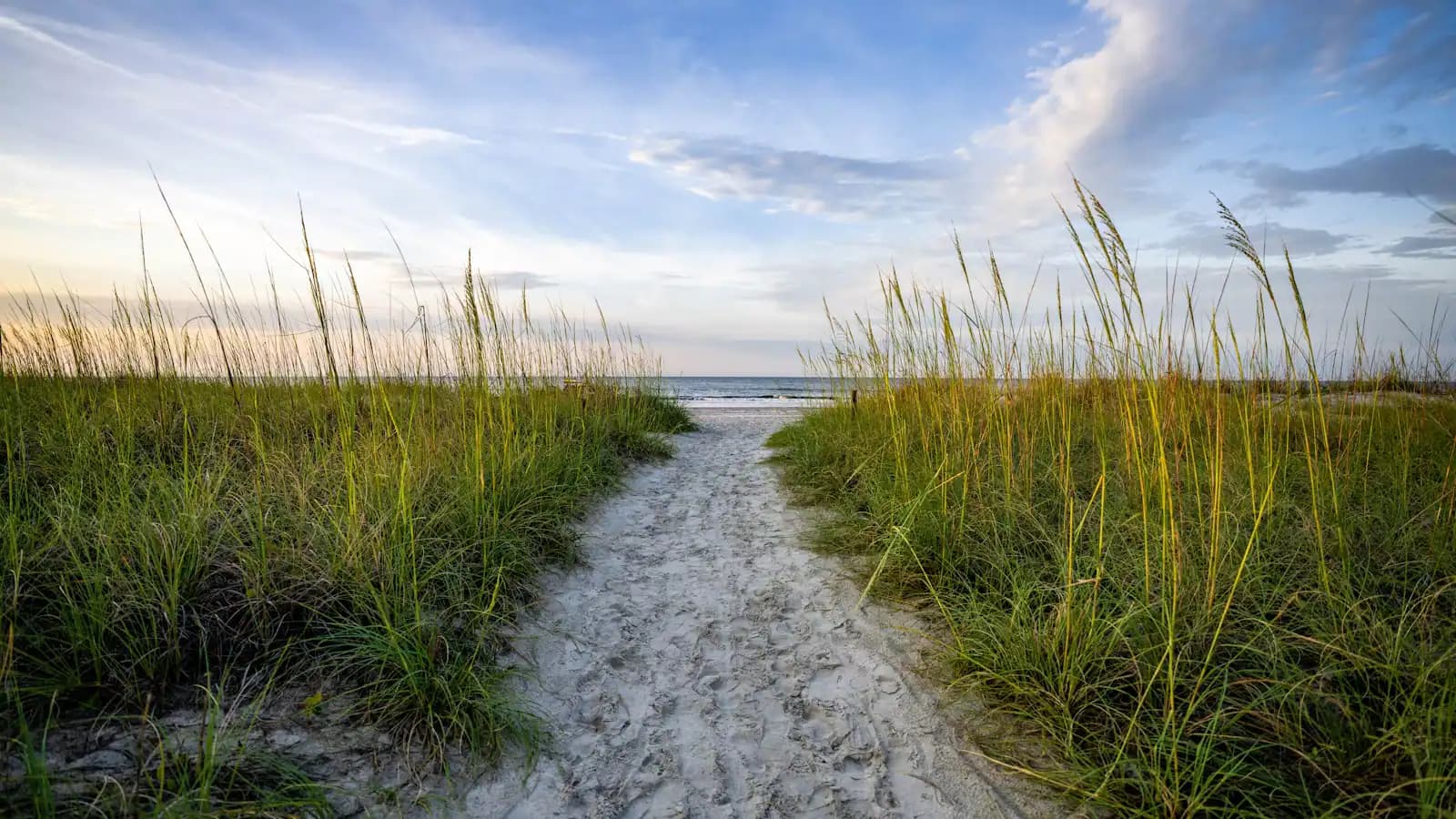
Then there is the part no map shows. For a few hours either side of low tide, roughly twelve miles of beach firms up into a surface better than any bike path on the island, and riding it is an ordinary local habit rather than a stunt.
Riding the beach, which is the whole point
Get a tide chart before you plan anything. The usable window is about two hours either side of low water. Outside it you are pushing a bike through soft sand and shell hash, and the difference between the two experiences is total.
Ride the damp, packed sand below the last high-tide line, where the surface is firm and the shells are fewer. Stay off the dunes and off the soft upper beach, both of which are protected and neither of which is ridable anyway. From May through October, stay well clear of any marked or staked sea turtle nest, and do not ride over a track line that the patrol may still be reading at dawn.
Fat tyres help but are not required; a standard beach cruiser handles the wet sand fine. What is required is rinsing the bike afterwards. Salt and sand will destroy a drivetrain in a week, and rental shops will thank you for a two-minute hose down at the villa.
The classic version of this ride is Coligny Beach Park south toward Sea Pines at a falling tide, then back on the sand as the water turns. Do it early: the light is better, the beach is empty, and the heat in July has not arrived.
Routes by distance
| Distance | Route | Notes |
|---|---|---|
| 4–5 miles | Coligny Beach Park to Sea Pines Circle and back via the Pope Avenue and Palmetto Bay Road paths | Flat, busy, all paved. Good first ride to test who in the family can actually cycle |
| 8–10 miles | Shelter Cove Harbour to Coligny and back, out along the William Hilton Parkway path and home on the beach at low tide | The best introduction to the island. Cross US-278 only at a signalised crossing |
| 10–12 miles | Inside Sea Pines: Harbour Town to South Beach Marina, then the Forest Preserve loop | Seventeen miles of private trail, no through traffic, alligators visible from the boardwalks. Day visitors cannot enter Sea Pines by bicycle, so this one is for guests |
| 12–15 miles | Palmetto Dunes lagoon paths to Folly Field and Driessen, returning along the beach | The lagoon system runs eleven miles and is completely traffic-free |
| 20 miles-plus | North end: Jarvis Creek Park to Fish Haul Creek Park and Historic Mitchelville Freedom Park, returning via Squire Pope Road | Quietest riding on the island, least shade, and worth combining with the low-tide flats at Fish Haul |
The crossings that matter
Almost all of the island's cycling risk is concentrated at a handful of points where a path meets a road carrying real traffic.
William Hilton Parkway, the US-278 business route, is the main one. It runs the length of the island with paths on both sides, and crossing it mid-block is how people get hurt. Use the signalised crossings and the underpasses. Press the button and wait for the phase, even when it feels excessive.
Sea Pines Circle and Coligny Circle are traffic circles with path crossings at their approaches. Drivers entering a circle are looking left at other cars, not right at a cyclist on a path. Dismount and walk it if you are riding with children. Everyone local will understand.
Palmetto Bay Road and Arrow Road, mid-island, carry more commercial traffic than their speed limits suggest, with vehicles turning across the path into car parks. Ride the path at a pace that lets you stop for a turning van.
Gate approaches at Sea Pines, Palmetto Dunes, Shipyard and Port Royal mix cars queuing for a pass with cyclists filtering past. Expect doors, reversing and confused first-day drivers.
Night riding
Paths here are genuinely unlit, and under a live oak canopy at 9pm the darkness is total. South Carolina requires a white light on the front and a red reflector at the rear after dark, and on this island the law is the bare minimum rather than the target. Fit a rear light as well. Rental shops will supply lights on request, but the request has to be made, so ask when you book rather than at collection.
Riding the beach after dark during the May-to-October nesting season is a bad idea and a discourteous one: hatchlings emerge at night, white light disorients them, and the town's lights-out ordinance exists precisely to keep the beach dark between 10pm and 6am.
Renting: what to get and how it arrives
Delivery to your villa is the island norm, not an upsell. Shops drop the bikes at the house, collect them at the end of the week, and stock trailers, tag-alongs, child seats, baskets and helmets alongside.
Expect cruisers from around $20 a day, hybrids nearer $40 and e-bikes around $60, with weekly rates bringing the per-day cost down sharply and free delivery common on rentals of three days or more. Confirm current pricing when you book, and confirm the helmet count, because small sizes run out first in July.
For a flat island with no hills, a single-speed cruiser is genuinely enough for most riders. Take the hybrid if you intend to cover the length of the island in a day, and take the e-bike if the group has a wide fitness range and you would rather not split up.
Riding with children
This is the island's real family selling point. Interior paths inside Palmetto Dunes, Shipyard and Sea Pines carry almost no through traffic and are where most children learn to ride a holiday route unsupervised for the first time.
A trailer takes two small children or the entire beach kit; a tag-along suits a five to eight year old who can pedal but cannot judge traffic. Set a meeting point rather than a route for older children, and make the tide the discipline: everyone is back before the beach goes soft.
What to take on a ride here
Water, and more of it than feels sensible. The island is flat, so riders underestimate the effort, and the humidity in July and August does the rest. There are drinking fountains at the beach parks and at Harbour Town, and long gaps between them on the north end.
A tide chart or an app with one. Any route that includes the beach is governed by it, and the return leg is the one that gets caught out.
Lights, not just reflectors, if there is any chance of being out past sunset. Sunset here moves about three hours across the year, from near 8.30pm in late June to around 5.20pm in December, which catches visitors out in autumn.
Insect repellent for anything that touches a marsh path at dawn or dusk, particularly the Pinckney Island causeway and the north-end trails. No-see-ums here are small enough to pass through mesh and are worst in still air.
A lock, even though the island is low-crime. Bikes left at a beach access for three hours are the exception to most people's luck.
Last updated
Opening hours, ordinances and prices move with the season. We re-check this guide rather than rewrite it, and the date above is the last time someone did. How we research and correct.