On this page
Hilton Head Island runs roughly twelve miles from Port Royal Sound in the north to Calibogue Sound in the south, covers about 42 square miles, and looks on a map like a shoe pointed at Savannah. The important thing to understand before you arrive is that this island was planned rather than grown. Since the 1970s the town and the big communities have enforced ordinances that keep signs small, buildings low and parking lots behind tree screens. There is no neon and there are no high-rises. The result is one of the most pleasant developed beach destinations on the Atlantic coast, and also the reason you will drive past your restaurant twice on the first evening. Put the address in your phone. Do not look for a sign.
The three ends of the island
North end
US-278 crosses the bridges and lands you here, at the top of the shoe. This is Hilton Head Plantation, Port Royal, Indigo Run and Palmetto Hall, plus the town's quietest public shore at Fish Haul Creek Park, where the low-tide flats are shell-rich and the birding is better than the swimming. Historic Mitchelville Freedom Park is next door on Beach City Road. The north end suits people who want to get off-island easily, to Bluffton for dinner or Savannah for a day, and who do not mind a twenty-five minute drive to Coligny in July traffic.
Mid-island
Broad Creek cuts in from the west almost far enough to cut the island in two, and the land either side of it is the practical middle: groceries, the hospital, Shelter Cove Towne Centre, and the marinas where most dolphin cruises, kayak trips and fishing charters actually leave from. Palmetto Dunes sits on the ocean side with an eleven-mile lagoon system running through it. Folly Field and Driessen beach parks are here, and so is Chaplin Community Park behind Burkes Beach. If you want to be equidistant from everything, this is it.
South end and Sea Pines
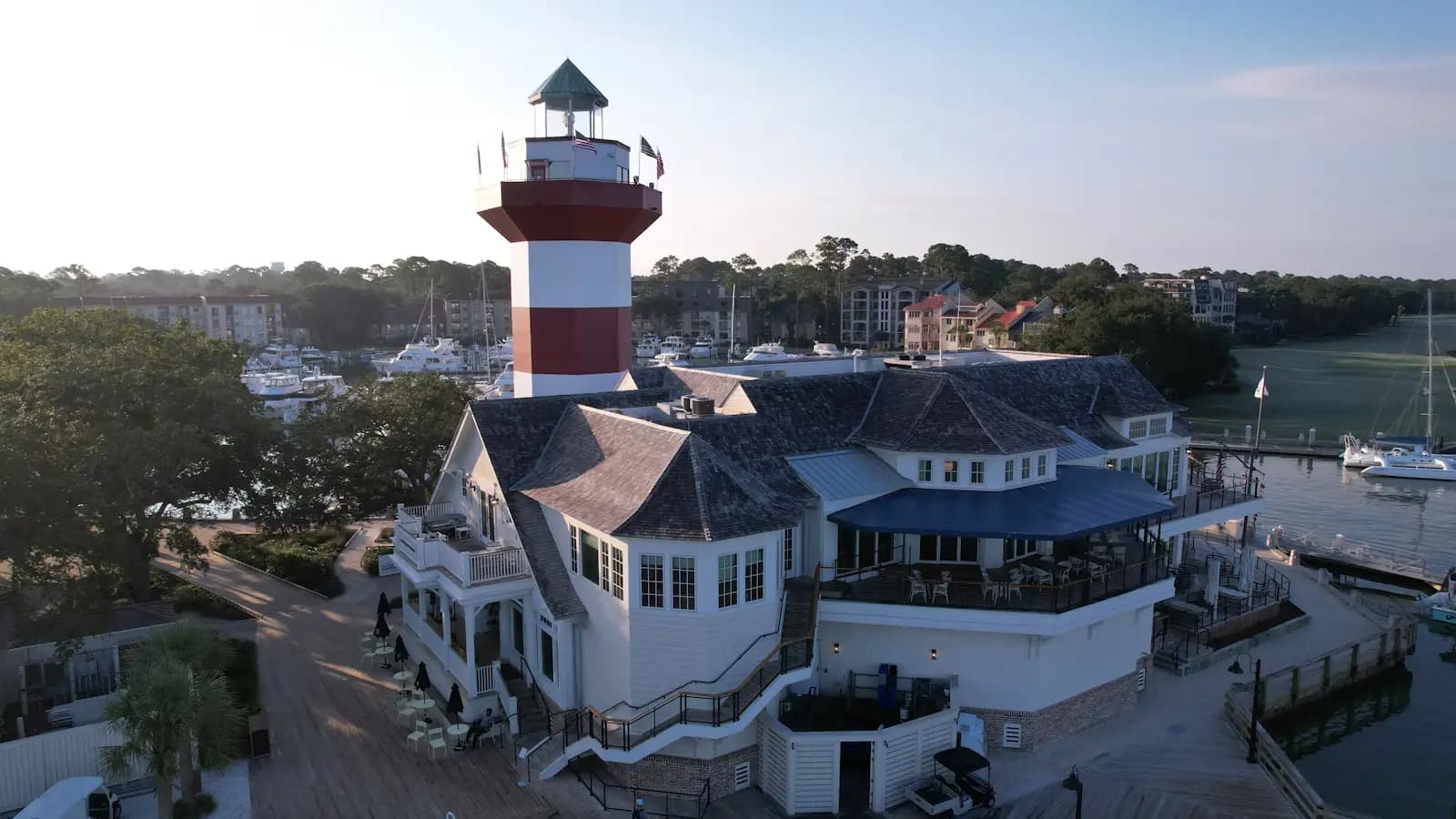
The south end is the most walkable part of the island. Coligny Circle, Coligny Plaza and Coligny Beach Park sit within a few hundred yards of each other, and Shipyard is next door. Behind its own gates, Sea Pines occupies the whole toe of the shoe: Harbour Town and its red-and-white lighthouse, the 605-acre Forest Preserve, the Stoney-Baynard ruins, South Beach Marina and about seventeen miles of private leisure trail. Most first-timers picture Sea Pines when they picture Hilton Head, and then discover it is a gated community with a day rate.
Gates, passes, and the toll that is no longer there
Sea Pines charges casual visitors a daily vehicle pass, published at $10 for a standard two-axle car, with weekly passes from around $30. You buy it at the Greenwood Gate on Greenwood Drive or the Ocean Gate off Cordillo Parkway, both selling passes roughly 7am to 11pm. If you are renting inside Sea Pines your pass comes with the rental. One workaround that does not work: the community's published visitor policy says day visitors who are not staying inside may not enter by bicycle. Rates change, so check before you budget a week of daily passes; if you plan to go in more than twice, buy the weekly.
The other gated communities operate differently. Palmetto Dunes, Shipyard, Port Royal and Hilton Head Plantation have staffed gates but no casual day rate for general visitors, and you pass through on a rental confirmation, a restaurant reservation or a tee time.
Now the money you do not have to spend. The Cross Island Parkway, the 7.5-mile expressway that opened in 1998 and cuts diagonally from the north end to Sea Pines Circle, was a toll road for twenty-three years. Collections ended on 30 June 2021 once the construction bonds were repaid, and the plaza has since been removed. Guidebooks and blog posts still tell you to keep quarters in the console. You do not need them. Use the Cross Island rather than William Hilton Parkway whenever you are crossing the island in summer and you will save yourself a string of traffic lights.
Where to base yourself
| If you are | Look at | Because |
|---|---|---|
| A family with children under ten | Palmetto Dunes or Shipyard | Flat interior paths, lagoons, short ride to the sand, bike delivery to the door |
| A couple on a long weekend who would rather not drive | South end near Coligny, or inside Sea Pines | Beach, restaurants and shops within walking distance of each other |
| Here for golf | Sea Pines, Palmetto Dunes, Port Royal | Courses on site, and you are not crossing the island at 7am |
| Watching the budget | North end and Folly Field, or mainland Bluffton | Rentals price lower away from the south end; Bluffton is about twenty minutes off-island |
| Flying out of Savannah early | Bluffton or the north end | Roughly 45 minutes to SAV instead of an hour-plus from Sea Pines |
Think like a cyclist before you think like a driver
The town maintains more than 72 miles of public pathway, and the private communities add another 50-odd miles inside their gates, Sea Pines contributing about seventeen on its own. The League of American Bicyclists rates Hilton Head a Gold-level Bicycle Friendly Community, which for a town of this size is unusual. Paths are flat, paved, separated from traffic and shaded for most of their length.
Then there is the beach itself. At low tide roughly twelve miles of hard-packed sand opens up, and riding it is a local habit rather than a novelty. Fat tyres help but are not essential. Check a tide chart before you set out, because the same route two hours later is soft sand and shell hash.
Rental shops deliver to your villa and collect at the end of the week, which is the normal way to do it here. Expect cruisers from around $20 a day, hybrids nearer $40 and e-bikes around $60, with weekly rates bringing the daily cost down sharply and free delivery common on rentals of three days or more. Confirm current pricing when you book. South Carolina requires a white front light and a rear reflector after dark, and the paths are genuinely unlit.
What catches first-timers out
- Saturday traffic. Most weekly rentals turn over on Saturday, and US-278 backs up at the bridges in both directions. Arrive Sunday if you can, or arrive after 4pm.
- Beach parking is paid, app-only, and seasonal. Town lots charge $3 an hour on weekdays and $5 at weekends, enforced 7am to 5pm from 1 March to 7 September, paid through a phone app rather than a meter. Coligny Beach Park is the exception: free, all year, nearly 400 spaces.
- The lights-out ordinance. From May through October, lights visible from the beach must be off or shielded between 10pm and 6am so loggerhead hatchlings are not drawn inland. It applies to your rental's deck lights.
- No glass on the beach, and dogs are restricted by season and time of day. The town enforces both.
- Sunset moves about three hours across the year here, from close to 8.30pm in late June to around 5.20pm near the winter solstice. Book sunset cruises to the actual time, not the season.
- The lagoons hold alligators. They are ordinary and mostly uninterested. Do not feed them, and keep dogs away from the water's edge.
- Hurricane season runs 1 June to 30 November, with the genuine risk concentrated in August through October. If you are booking in that window, buy the insurance.
What a week here actually costs
These are planning bands rather than quotes, and they move with season and demand. Verify anything you are budgeting against.
- Accommodation is the whole ballgame. A two-bedroom villa off the beach in March or late October can land near the bottom of the island's range; the same unit in the second week of July can double or better. Oceanfront homes are their own market.
- Beach parking, at $3 to $5 an hour in season, runs a few dollars a day if you park at a town lot for a morning, or nothing at all if you use Coligny or ride a bike.
- A Sea Pines day pass is published at $10 per car; a weekly pass starts around $30 and pays for itself on the third visit.
- Bikes for a family of four for the week typically come in under the cost of one dinner out, delivered and collected.
- A shared dolphin cruise runs roughly $35 to $50 an adult for 90 minutes to two hours, with children discounted.
- Groceries are ordinary supermarket prices, and the island has full-size stores at both ends, so provisioning a rental kitchen is the single biggest saving available to a family here.
A sane first 48 hours
Do not try to see the island on day one. Collect the rental, provision the kitchen, and walk to the nearest beach access to work out where you are.
On the first full morning, ride or drive to whichever beach park is closest and go at low tide, which is when the sand is widest and firmest and when the island's beaches make the best case for themselves. Save Harbour Town for a late afternoon, when the light is better and the day-pass queue at the Sea Pines gate has thinned.
Book one boat trip early in the week rather than late. Weather cancels departures, particularly in July and August when thunderstorms build over the mainland in the afternoon, and an early booking leaves you room to be rescheduled. Morning departures are calmer, cooler and better for anyone prone to seasickness.
Keep one day with nothing in it. The most common regret from first-timers is not that they missed an attraction, but that they scheduled a barrier island like a city.
Last updated
Opening hours, ordinances and prices move with the season. We re-check this guide rather than rewrite it, and the date above is the last time someone did. How we research and correct.