Skip to content
Menu

We earn a commission if you book through this link. You pay the same price.

Things to Do

Shopping on Hilton Head Island

Last updated

Where to shop on Hilton Head Island: Coligny Plaza, Shelter Cove Towne Centre, the Tanger outlets in Bluffton, galleries, markets and what to buy.

Shopping on Hilton Head looks different from shopping anywhere else because of an ordinance. The island's sign rules cap size, ban internal illumination and require muted colours, and the building code keeps everything low and behind trees. There is no neon, no roadside pylon and nothing taller than the canopy. The practical effect is that you drive past shopping centres without noticing them, and that the same centre looks like a row of weathered wooden buildings rather than a strip mall. It also means you need to know where you are going before you set off.

There is no enclosed mall on the island. Retail divides into four island centres with distinct jobs and two outlet campuses on the mainland. Coligny Plaza at the south end is the one you walk to from the beach: around 60 independent shops, restaurants and kiosks, including beachwear, jewellery, a toy shop, a pharmacy, a hardware store and a small cinema that programmes independent films. Shelter Cove Towne Centre on Broad Creek is the practical one, anchored by Belk and Kroger with 35-odd shops around them and a park with a playground and an entertainment pavilion. Harbour Town's shops sit around the yacht basin inside Sea Pines, small and resort-priced, and the Village at Wexford mid-island holds a handful of long-running boutiques.

The outlets are in Bluffton, before the bridges. Tanger Hilton Head runs as two separate open-air centres about a mile apart on US-278, with more than 90 stores between them, which is worth knowing before you circle one looking for a brand that is in the other. Combine the trip with Old Town Bluffton rather than making a special journey, and avoid a summer Saturday when the bridge traffic is at its worst.

What is actually worth buying is a shorter list than the square footage suggests. Sweetgrass baskets from Gullah Geechee makers, indigo-dyed textiles worked from a crop Daufuskie once grew commercially, local art and photography, Lowcountry food to take home from the Bluffton Oyster Company, and the Salty Dog t-shirt that has been the island's unofficial uniform for decades. Most of the rest is stock you can buy at home, at outlet prices you can also get at home.

Coligny Plaza: the one you will walk to

Coligny Plaza sits at Coligny Circle on the south end, directly across the road from the island's busiest beach park, and it is the closest thing Hilton Head has to a downtown. Around 60 shops, restaurants and kiosks fill an open-air block that has grown organically since the 1950s, which is why the layout makes no sense and is part of the appeal.

The mix is genuinely independent. Beachwear and surf shops, a long-running toy store, jewellery, gift shops, a pharmacy, a hardware store that has saved more than one rental week, bike rental counters, ice cream, and a small cinema that has programmed independent and art films since it was converted from the island's original theatre. Restaurants run from counter-service to sit-down, and several have live music in the evening.

Parking is free, which is the other reason everyone ends up here. It is also why the lot is full from mid-morning through the afternoon in July. The workaround is the one locals use: ride a bike, since the pathway network reaches Coligny from every direction and there is no charge for two wheels.

Go in the evening if you can. The plaza is at its best after the beach empties out, when the shops stay open late in season, the crowd thins and the whole place feels like a small town rather than a car park.

Shelter Cove Towne Centre: the practical one

Shelter Cove Towne Centre on Shelter Cove Lane, mid-island beside Broad Creek, is where a rental week actually gets provisioned. Belk and Kroger anchor it, with around 35 shops and restaurants between them: clothing, a running shop, a jeweller, homeware, a coffee chain, an ice cream and chocolate shop, and a run of national names.

The centre includes Spartina 449, the local handbag and accessories brand named after the spartina marsh grass that fills the creeks around it, which is one of the few genuinely local labels that has scaled beyond the island.

The reason to come even without a shopping list is the park. A community green with a playground and an entertainment pavilion sits at the water end, with a walking path along Broad Creek and a good view over the marsh. There is live music on summer evenings and space for children to run while someone else finishes in Kroger.

Across the road, Shelter Cove Harbour and Marina is a separate place with its own character: the Neptune statue, boutiques around the docks, Tuesday-night fireworks in summer, and the departure point for a large share of the island's dolphin and sunset cruises. Treat the two as one stop and give yourself a couple of hours.

Harbour Town, the Village at Wexford and the marinas

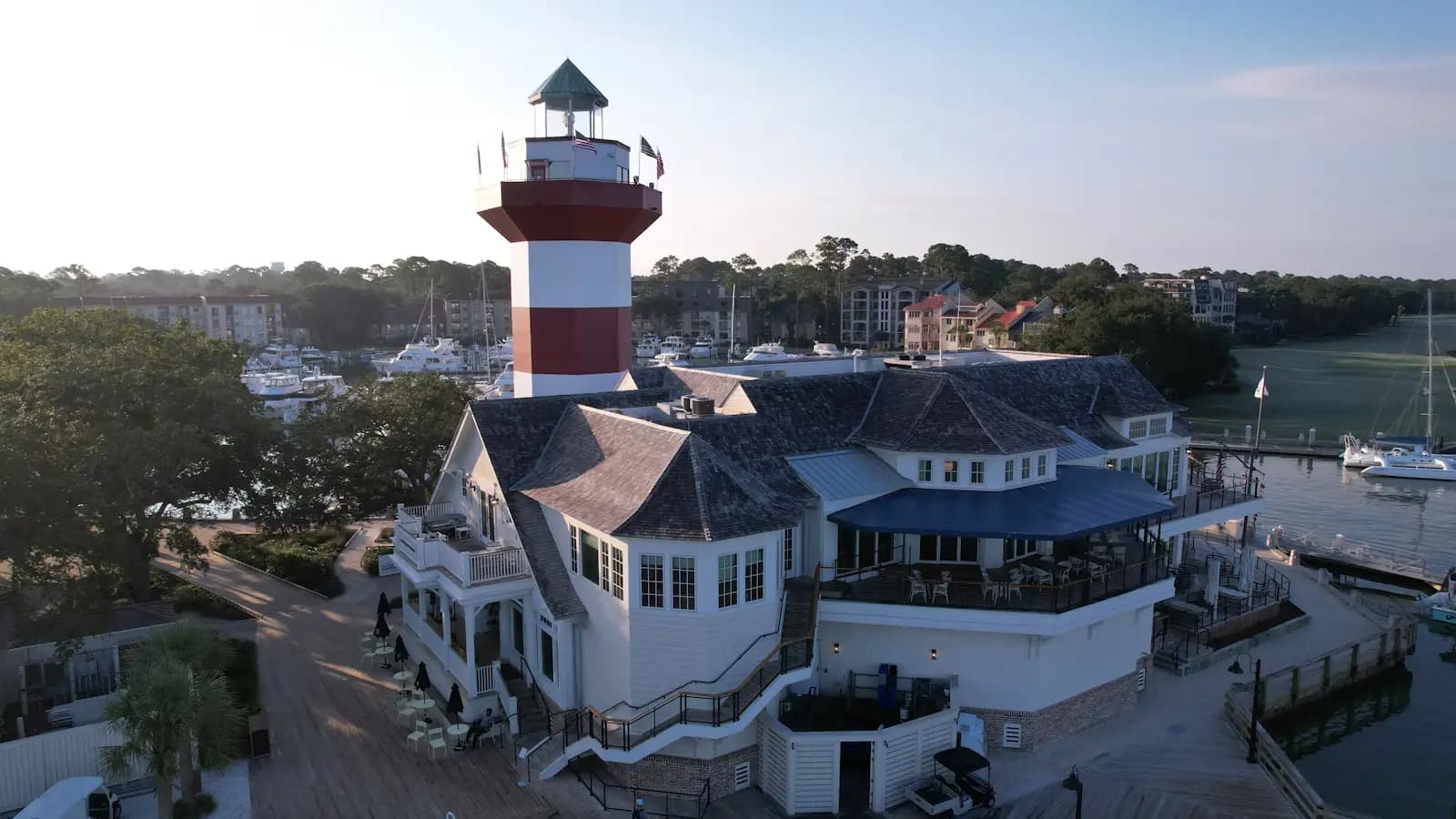
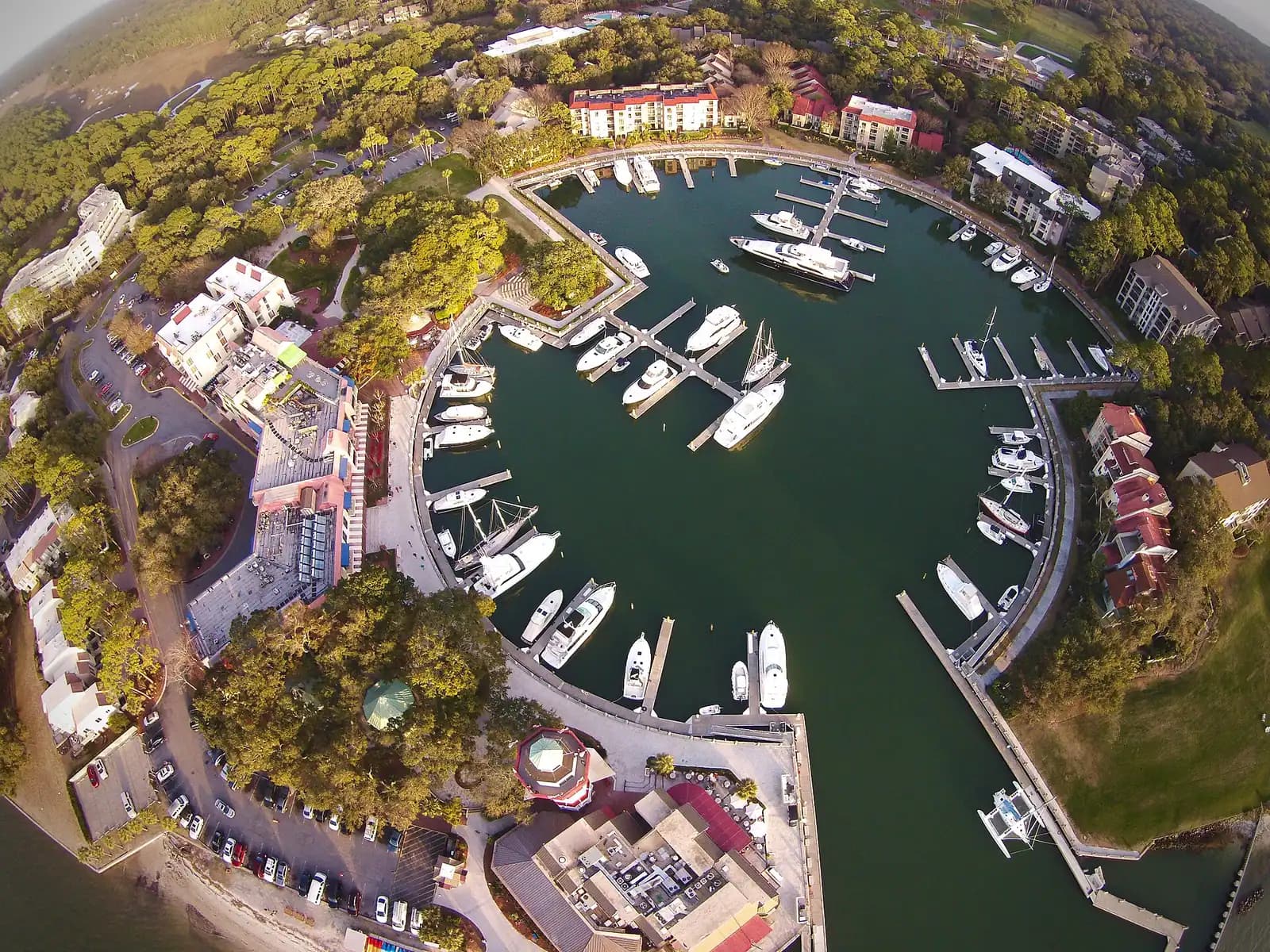
Harbour Town's shops ring the yacht basin in Sea Pines beneath the red-and-white lighthouse: small boutiques, resort wear, a gallery or two, gifts and children's clothing, all at resort pricing. It is a pleasant hour and a genuinely lovely setting, particularly in the late afternoon with the boats in and a musician playing under the Liberty Oak. Remember that Sea Pines charges a daily pass per vehicle at the gate for non-residents, so factor that in if shopping is your only reason for going. Arriving by bike avoids it, since the charge is per vehicle.

South Beach Marina, also in Sea Pines, is where the Salty Dog Cafe sits. The t-shirt has been the island's unofficial souvenir for decades and you will see it on every third person at the airport. Buy it at the source rather than from a rack somewhere else.

The Village at Wexford, mid-island on William Hilton Parkway, is a smaller centre of long-established independent shops and restaurants, including kitchenware and clothing boutiques that have been there for years. It is the sort of place people who own houses here shop, which is a reasonable recommendation.

Port Royal Plaza and Main Street Village on the north end round out the list, more practical than pretty, and useful if you are staying that end of the island.

Galleries, artists and the markets

The island supports more art than its size suggests. The Art League of Hilton Head runs a gallery at the Arts Center of Coastal Carolina at Shelter Cove and an academy elsewhere on the island, showing and selling work by local member artists. Several commercial galleries operate around Shelter Cove and the south end, with a strong Lowcountry landscape and marsh-photography bias.

Cross to Bluffton for the denser concentration. Old Town's Calhoun Street is lined with studios and galleries, and the Society of Bluffton Artists keeps a gallery there. Artists in Bluffton tend to be working in the buildings they sell from, which makes conversation easy and the prices more transparent.

Two markets are worth planning around. The farmers market at the Coastal Discovery Museum at Honey Horn runs on Tuesdays, with produce, Lowcountry food producers and craft under the live oaks. The Bluffton farmers market runs on Thursdays, in the afternoon for most of the year and in the morning through high summer. Both shift hours seasonally, so confirm before making a special trip.

For Gullah Geechee craft, particularly coiled sweetgrass baskets, buy from makers and from organisations that represent them rather than from a gift shop rack. The work takes days to make, the pricing reflects that, and the provenance matters.

What is actually worth buying here

Local tips

A short list that will not embarrass you at home:

  • Sweetgrass baskets. Coiled by hand from sweetgrass, pine needle and palmetto, a Gullah Geechee craft carried from West Africa and still practised in the Lowcountry. Expensive for a reason. Buy from makers.
  • Indigo-dyed textiles. Daufuskie grew indigo commercially, and a studio on the island still dyes with it. Scarves, napkins and shirts, and the dye lot is genuinely local.
  • Local art and marsh photography. The light on spartina at low tide is the region's actual subject, and there is a lot of good work at reasonable prices.
  • Food to take home. Shrimp and oysters from the Bluffton Oyster Company on the May River in season, benne wafers, stone-ground grits, local honey, boiled peanuts from a roadside stand.
  • Spartina 449. A local label with a genuine Daufuskie origin story.
  • The Salty Dog t-shirt. Unashamedly touristy, entirely of this island, and it will outlast most of what you buy at the outlets.

What to skip: airbrushed beach tees, shark-tooth necklaces of unverifiable origin, and shells sold in bulk. On that last point, take nothing live off the beach yourself. South Carolina prohibits collecting live shells, sand dollars and conchs, and a beach patrol officer will happily explain the rule to you.

Tanger outlets: two centres, one highway

How they compare

The outlets are on the mainland in Bluffton, on US-278 before the bridges, and they come as two separate open-air centres roughly a mile apart on the same side of the highway. More than 90 stores are split between them. Visitors regularly arrive at one, fail to find the brand they came for, and leave without realising the other exists.

Broadly, the two centres carry different mixes, with the nearer-to-the-bridge centre and the further one each holding their own set of names. Check the current store directory online before you drive over and decide which one you actually need, because moving between them means getting back on US-278.

Timing matters more here than at any other retail on this list. The outlets sit squarely on the corridor that backs up on summer Saturdays when the island's weekly rentals turn over. Go on a weekday, or early. Combine the trip with Old Town Bluffton, which is ten minutes further, and the drive starts to look sensible rather than like a wasted beach morning.

An honest word on value. Outlet pricing here is what outlet pricing is anywhere: some genuine markdowns, some made-for-outlet stock, and the usual gap between the sign on the door and the price on the tag. If you are coming from a country where these brands are expensive, the maths works. If you are American, do not build a day around it.

On the ground

Where to go

Every place below has its own page — hours, parking, what it costs and what to expect when you get there.

  • Small boats moored on clear shallow water beside a sandbank, seen from above

    Marina

    Harbour Town

    A yacht basin on Calibogue Sound, a three-centuries-old live oak, and the island's most photographed stretch of low wooden shopfronts.

    1–3 hoursNo charge to walk the harbour, but Sea Pines charges a daily gate pass per vehicle to enter the community.

  • A raised timber boardwalk running through dense green woodland

    Museum

    Coastal Discovery Museum at Honey Horn

    Free

    Sixty-eight acres of marsh boardwalk, live oak allee and camellia garden, free to walk, with the island's best interpretation indoors.

    1–2.5 hoursFree entry to the museum and the 68-acre grounds. Donations encouraged.

  • A wide-crowned oak with low limbs and sunlight through the leaves

    Neighbourhood

    Old Town Bluffton

    Free

    Twenty minutes off the island: art galleries on a one-street town, an 1857 church on a bluff, and oysters shucked by hand.

    2.5–5 hoursFree to visit and free to park. You pay only for food, art and anything you buy.

  • A bright, open dining room with long communal tables and large windows

    Shopping

    Coligny Plaza

    Free

    Sixty-odd shops and restaurants in a low, open-air block across the road from the island's busiest beach — and the parking is free.

    1–3 hoursFree to visit, free to park. You pay only for what you buy.

  • A bright open interior with high ceilings and long tables

    Shopping

    Shelter Cove Towne Centre

    Free

    The island's practical shopping stop on Broad Creek: a supermarket, real shops, free parking and a waterside park, with no gate to pass.

    1–3 hoursFree to visit, free to park, no gate pass. You pay only for what you buy.

Straight answers

Questions people actually ask

Is there a mall on Hilton Head Island?

No enclosed mall. The island's sign and building ordinances keep retail low, wooden and hidden behind trees, so shopping is spread across open-air centres: Coligny Plaza at the south end, Shelter Cove Towne Centre mid-island, Harbour Town inside Sea Pines, the Village at Wexford, and a few practical plazas on the north end. The closest thing to a mall is the Tanger outlet pair in Bluffton, over the bridge.

Where are the outlet stores near Hilton Head?

In Bluffton on the mainland, on US-278 before the bridges. Tanger Hilton Head is two separate open-air centres about a mile apart on the same side of the highway, with more than 90 stores between them. Check the store directory before you drive, because your brand may be in the other centre. Avoid summer Saturdays, when the bridge corridor backs up with rental turnover traffic.

Do you have to pay to shop at Harbour Town?

Not for the shops, but Sea Pines charges a daily pass per vehicle at the gate for anyone who is not staying inside the community. The charge is per car rather than per person, so a full car pays once, and cyclists and pedestrians are not charged at all. If shopping is your only reason for going, factor the gate into the cost or ride in on the pathway network.

What should you buy as a souvenir from Hilton Head?

Sweetgrass baskets from Gullah Geechee makers are the most meaningful thing you can carry home, hand-coiled from sweetgrass, pine needle and palmetto. After that: indigo-dyed textiles worked from a crop Daufuskie once grew, local marsh photography and art, Lowcountry food such as benne wafers, stone-ground grits and local honey, and the Salty Dog t-shirt from South Beach Marina, which is unashamedly touristy and entirely of this island.

Are there farmers markets on Hilton Head?

Yes. The farmers market at the Coastal Discovery Museum at Honey Horn runs on Tuesdays under the live oaks, with produce, Lowcountry food producers and craft. Over the bridge, the Bluffton farmers market runs on Thursdays, in the afternoon for most of the year and mornings in high summer. Both change hours seasonally, so check the current schedule before planning a trip around one.

Where do people shop for groceries on Hilton Head?

Kroger at Shelter Cove Towne Centre is the main mid-island supermarket, and there are other full supermarkets on the north end and toward the south end. Plan the big shop for the day you arrive rather than a Saturday afternoon, when the whole island is turning over its rentals. For seafood, the better answer is the Bluffton Oyster Company over the bridge, where shrimp and oysters come off the boats in season.

Can you take shells and sand dollars home?

Empty ones yes, live ones no. South Carolina prohibits taking live shells, including live sand dollars, conchs and whelks. If it is moving, has an animal inside or was buried in wet sand at the tide line, put it back. The best shelling on the island is on the north end around Fish Haul Creek Park at low tide. Shells sold in bulk in gift shops are generally not from this beach.

What are shop opening hours like on Hilton Head?

They are seasonal, and that catches visitors out in winter. In peak season the island centres stay open into the evening, especially Coligny Plaza, and Harbour Town keeps resort hours. From late autumn through February, many independent shops shorten hours, close an extra day or take a break entirely. Check before making a special trip out of season rather than relying on posted hours from summer.