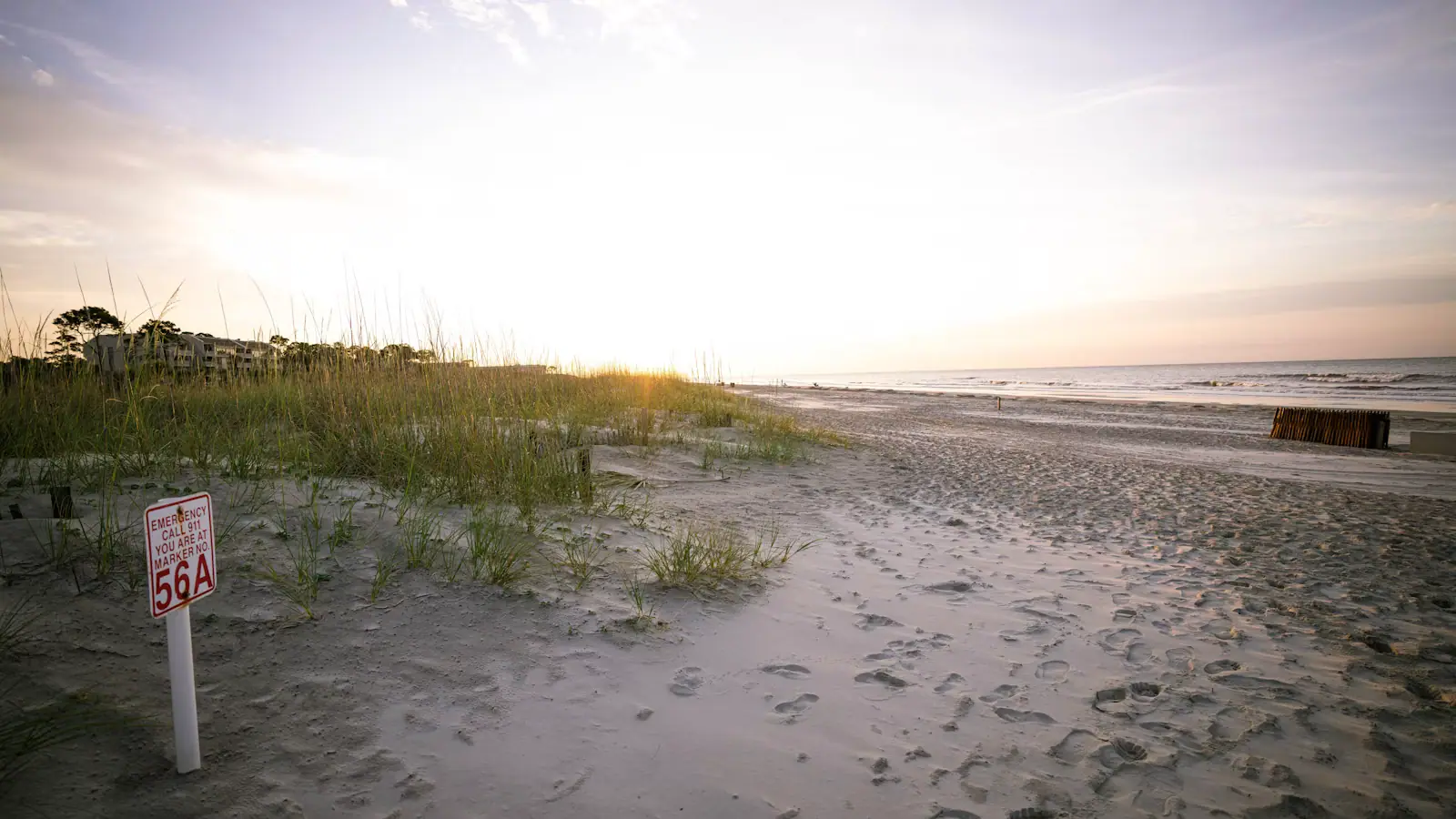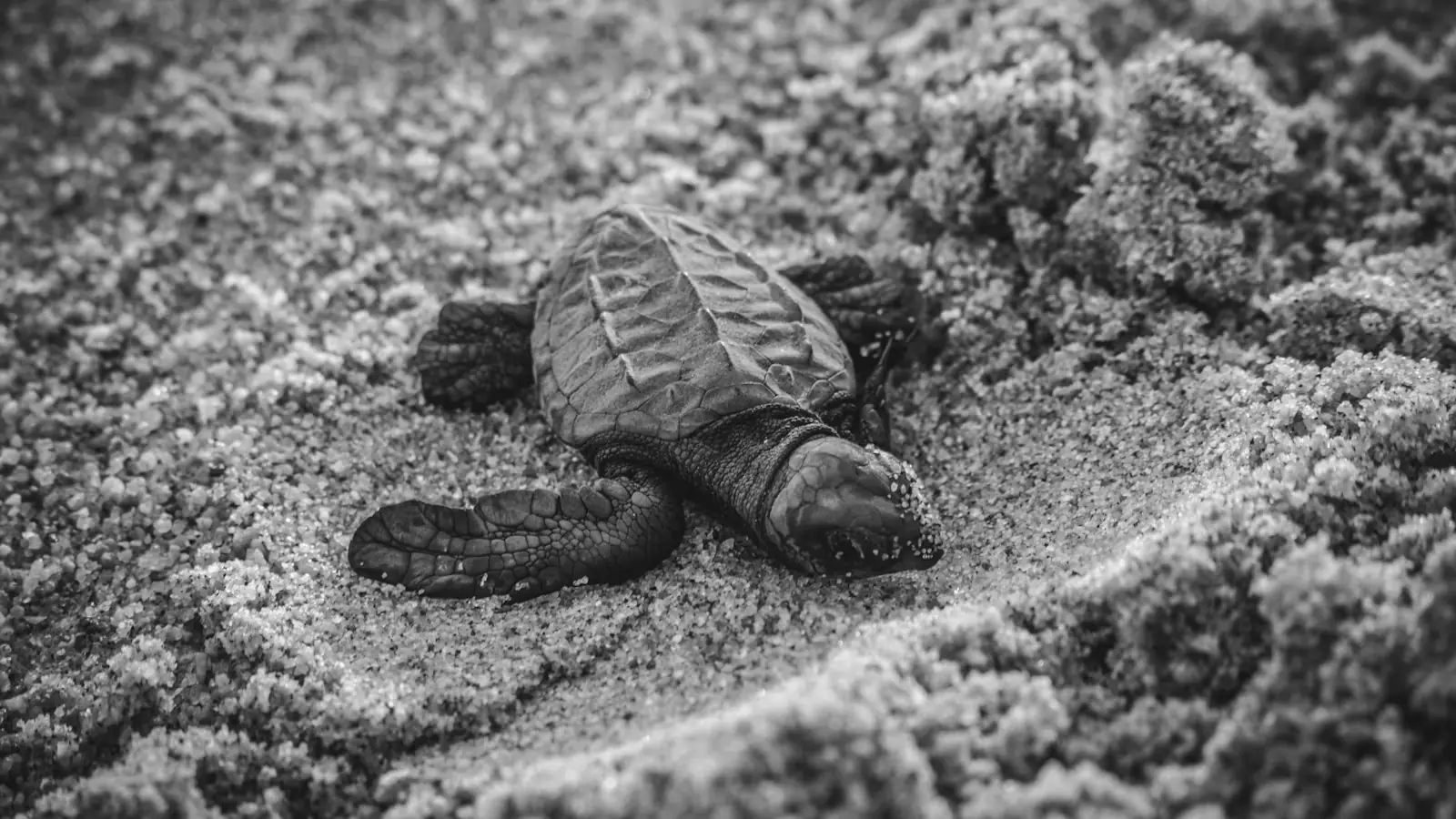
Between May and October, loggerhead sea turtles haul out onto Hilton Head's beaches at night, dig, lay around a hundred eggs each and go back into the Atlantic. In the 2025 season the island recorded 237 nests. Every one of them was found, marked and monitored by volunteers who walk the beach at first light.
If you are here in those months, the season is not something you watch. It is something you are part of, mostly through small decisions about lights, holes and where you leave the beach chairs.
The species and the schedule
The loggerhead, Caretta caretta, is the nesting turtle here, listed as threatened under the Endangered Species Act. Green turtles and leatherbacks turn up on this coast occasionally, but a Hilton Head nest is almost always a loggerhead.
A nesting female comes ashore at night, usually alone, crawls above the high-water line, digs a body pit and then a flask-shaped egg chamber with her rear flippers, lays her clutch, covers it, disguises the site and returns to the water. The whole thing takes an hour or more, and the tracks she leaves are the reason the patrol walks at dawn. Not every crawl produces a nest: a female may be disturbed, or hit an obstruction, and turn back. The patrol calls that a false crawl and records it too.
Incubation runs roughly 55 to 60 days, and the temperature of the sand determines the sex of the hatchlings, warmer sand producing more females. Hatchlings emerge at night, usually as a group, and orient themselves toward the brightest, lowest horizon. On a natural beach that is the ocean, reflecting moon and starlight. On a developed one it can be a deck light, and a hatchling that crawls inland does not get a second attempt.
| Month | What is happening on the beach |
|---|---|
| May | First crawls of the season. Nesting begins; the lights-out ordinance comes into force |
| June | Peak nesting. Patrol volunteers walk the full beach at first light every day |
| July | Nesting continues; the earliest nests begin to hatch late in the month |
| August | Peak hatching, and still some late nesting |
| September | Hatching continues; nest inventories run three days after each emergence |
| October | The last nests hatch and the season closes |
The lights-out ordinance
The Town of Hilton Head Island requires that lights visible from the beach be turned off or shielded between 10pm and 6am during nesting and hatching season, May through October. It applies to rental homes and villas, not only to hotels, which means it applies to you.
In practice: close the ocean-facing blinds after dark, switch off deck and pool lights, and do not use a white flashlight or a phone torch on the beach at night. If you need light to walk, use a red or amber light, which hatchlings and nesting females are far less sensitive to. No flash photography, at all, of a nesting turtle or a hatchling.
This is the single most useful thing a visitor does here, and it costs nothing.
Sea Turtle Patrol Hilton Head Island
The island's monitoring is run by Sea Turtle Patrol Hilton Head Island, a registered non-profit working under permit from the South Carolina Department of Natural Resources. The programme has been walking these beaches since 1985.
Volunteers cover the island's beaches at first light through the season, reading the previous night's tracks, locating and marking nests with stakes, monitoring them from around day 45, recording emergences, and conducting an inventory three days after a nest hatches to count what emerged and what did not. That inventory data goes to SCDNR and feeds the state-wide picture of loggerhead recovery.
Two things follow from that. The stakes, tape and markers on the beach are research equipment, not decoration: do not move them, and do not let children swing on them. And the people you see on the beach at dawn in marked shirts are volunteers under permit. Handling a sea turtle or a nest without that permit is illegal.
What to do, and what never to do
If you find a nesting turtle at night, stop where you are and stay behind her, well back and quiet. Do not use any light. Do not photograph her with a flash. Do not touch her or get in front of her, because a disturbed female will abandon the attempt and go back to the water with her eggs.
If you find hatchlings, let them crawl. Do not pick them up, do not carry them to the water and do not put them in the sea. That crawl down the beach is how they orient themselves and build the strength for the swim that follows. What you can do is switch off every light you control, ask others to do the same, and keep people and dogs back to give them a clear run.
If hatchlings are heading the wrong way, or a turtle appears sick, injured or stranded, report it. SCDNR's statewide wildlife line is 1-800-922-5431, and it is the number to use for a sick, injured or dead sea turtle.
Never dig into a nest, and never attempt to move one. Nest relocation on this coast happens only under permit and only for good reason.
Fill in your holes before you leave the beach. A hole that a child dug in the afternoon is a trap for a nesting female or a hatchling at 2am, and for a volunteer walking at dawn. Knock down the sandcastles too.
Take everything off the sand overnight. Chairs, umbrellas, tents, coolers and toys left out are obstructions that turn a nesting attempt into a false crawl. Several stretches of this beach are patrolled precisely because of it.
How visitors can actually help
- Turn the lights off, close the blinds, and use a red light if you must use one.
- Fill holes and flatten castles as a matter of habit, not just on the last day.
- Pick up plastic, especially bags and balloon fragments. A drifting plastic bag is indistinguishable from a jellyfish to a turtle.
- Keep dogs leashed where the rules require it and well away from marked nests.
- Support the patrol. It is a volunteer non-profit; nest adoptions and donations fund the equipment that goes onto the beach every morning at dawn.
- If you are renting a house with ocean-facing lighting, ask the owner whether the fixtures are turtle-friendly. Enough guests asking changes what gets installed.
None of this needs you to see a turtle. Most visitors here never do, and the season works anyway.
Can you actually watch a nest hatch?
Probably not, and it is worth setting that expectation before your trip rather than after it.
Hatchlings emerge at night, on their own schedule, without warning. Nobody can tell you which nest will go or when, and the beach is dark by ordinance while it is happening. Organised turtle walks are not a feature of this island the way they are in a few other places, and nothing that promises you a guaranteed hatchling sighting should be trusted.
What does happen in public view are the nest inventories, conducted three days after a nest emerges, when volunteers excavate to count hatched shells, unhatched eggs and the occasional straggler. People on the beach at the time sometimes watch from a distance. These are working sessions carried out under permit rather than scheduled events, so treat one as a piece of luck: stand well back, keep quiet, keep dogs and drones away, and let the volunteers work.
The realistic version of a sea turtle experience here is a set of tracks in the sand at 7am and a staked nest above the tide line. That is a good morning, and it costs nothing.
Last updated
Opening hours, ordinances and prices move with the season. We re-check this guide rather than rewrite it, and the date above is the last time someone did. How we research and correct.